


Are Extendable Dining Tables Worth It? Here's What to Know
Summarize with AI
Get a quick summary of this article using your preferred AI assistant.


A dining table that comfortably seats your household every day might feel too small when friends or family visit. But buying a larger table for occasional gatherings can leave your dining area crowded the rest of the time.
That's where an extendable dining table comes in. It gives you a smaller tabletop for everyday meals and extra surface space when you need it.
So, are extendable dining tables worth it? For many homes, yes—especially when your seating needs change throughout the year. However, the extra flexibility comes with moving parts, possible storage requirements, and the need to plan for the table's largest size.
Here's how to decide whether an extendable table is a smart choice for your space, and what to check before buying one.
1. When Is an Extendable Dining Table Worth It?
The biggest advantage of an extendable dining table is flexibility. Instead of choosing a permanent table size based on your largest possible gathering, you can choose one that suits everyday life.
For example, a couple living in an apartment might only need a small table for daily meals. When friends come over for dinner, an expandable surface makes hosting easier without taking up that extra room every day.
An extendable dining table is particularly worth considering when:
- You host occasionally. Your everyday seating needs are smaller than your guest list for birthdays, holidays, or weekend dinners.
- Your dining space has multiple uses. You want room to move around normally but appreciate additional tabletop space for projects or gatherings.
- Your household needs may change. You want some flexibility without immediately replacing your dining furniture.
However, if you regularly need the table fully extended, a fixed dining table of the appropriate size may be simpler. You would avoid the additional extension hardware while getting a continuous tabletop for everyday use.
The goal isn't necessarily to buy the smallest table possible. It's to choose a table that works comfortably in its everyday configuration and remains practical when expanded.
2. The Pros and Cons of Extendable Dining Tables
An extendable table can make a dining room more adaptable, but it isn't automatically the better option. Consider what you gain and what you give up.
The advantages
More usable floor space most days
A smaller everyday footprint can leave more room around chairs, kitchen entrances, and nearby furniture. This can be particularly valuable in an apartment dining nook or an open-concept living area.
Extra tabletop space when guests arrive
Instead of bringing in a separate folding table, you can expand your existing dining surface. Depending on the design and dimensions, this may accommodate additional place settings or serving dishes.
One table for different activities
A compact table might work perfectly for everyday meals, while the extended surface offers more room for board games, crafts, working from home, or entertaining.
The drawbacks
More components to maintain
Unlike a fixed table, an extendable model has joints, runners, hinges, or other extension hardware. Construction quality, alignment, and regular care can affect how smoothly it operates over time.
Not every extension is equally convenient
Some tables have integrated extension sections, while others require separate leaves. If an extension panel must be stored elsewhere, you need accessible storage space.
The extended size can still crowd your room
A table that looks compact when closed might interfere with walkways, doors, or nearby cabinets once expanded. Measuring only the everyday dimensions is a common buying mistake.
Price and tabletop seams
Depending on the construction, an extendable table may cost more than a comparable fixed table. You may also notice joints between tabletop sections, which can affect the appearance and cleaning routine.
Ultimately, the most important question is whether the added flexibility is useful enough to justify these trade-offs.
3. How Much Space Do You Actually Need?
An extendable dining table only saves space when its smaller configuration makes a meaningful difference to your room. Before buying, measure both the closed and fully extended dimensions.
As a starting point, plan for around 36 inches between the table edge and a nearby wall or obstruction where dining chairs need to be pulled out. Where people must walk behind occupied chairs, allow more space—approximately 44 inches or more is a useful planning target.
These are general planning guidelines, not universal requirements. Your chairs, household mobility needs, doors, and traffic routes may require different clearances.
A Real-World Sizing Example
Take the smaller SHIFT configuration as an example:
- Closed tabletop: 47.2 × 31.5 inches
- Extended tabletop: 59.1 × 31.5 inches
- Additional tabletop length: 11.9 inches
If you plan for 36 inches of clearance on all four sides, the fully extended setup needs approximately:
- Length: 59.1 + 36 + 36 = 131.1 inches (about 10 ft 11 in)
- Width: 31.5 + 36 + 36 = 103.5 inches (about 8 ft 8 in)
This is an illustrative planning envelope rather than a required room size. A high-traffic side may need more space, while other arrangements can differ depending on chair use and obstacles.
Using the same 36-inch clearance allowance, the closed SHIFT table would need an approximate planning area of 119.2 × 103.5 inches (9 ft 11 in × 8 ft 8 in), compared with 131.1 × 103.5 inches (10 ft 11 in × 8 ft 8 in) when extended.
For example, if your available dining area is 10 feet long, the closed layout would leave less than an inch of extra length beyond the planned clearance, while the extended layout would exceed the available space. This leaves virtually no flexibility for measurement differences or room obstacles. Measure the entire dining area, including chair movement and walking routes, rather than just the tabletop.

Try the floor-tape test
Before ordering, mark the table's extended footprint on the floor using painter's tape. Pull out your existing dining chairs, walk around the setup, and check whether cabinets, doors, or kitchen pathways remain usable.
If the expanded layout interrupts how you normally move around your home, a smaller table—or a different extension direction—may be a better choice.
4. What to Check Before Buying
Beyond appearance and dimensions, the mechanism and materials determine how practical an extendable table will feel in daily use.
Understand the extension mechanism
Common designs include butterfly leaves that fold within the table, removable insert leaves, drop-leaf sides, and sliding extension sections.
The best mechanism depends on how frequently you extend the table. Ask whether the additional section stores inside the furniture, how it locks into position, and whether the table can be operated conveniently by your household.
Look for securely aligned tabletop sections, stable supports, and clear operating instructions. Avoid forcing a mechanism that sticks or feels misaligned.
Compare tabletop materials
Your choice of surface affects maintenance as much as appearance.
Oak wood offers a warm, natural appearance, with wood grain that can complement Scandinavian, minimalist, and contemporary interiors. Its finish needs appropriate care, particularly around spills, moisture, and heat.
Sintered stone provides a different look and is often selected for its resistance to common stains and everyday wear. However, it is not indestructible: edges can chip, and care instructions still matter.
Neither material automatically makes an extendable table more durable. The supporting frame, extension hardware, surface finish, and construction quality are all relevant.
Check chairs, legs, and delivery access
A larger tabletop does not automatically mean more comfortable seats. Measure how much usable edge each person gets and check whether table legs or supports interfere with knee room.
Also check entry doors, hallways, elevators, staircases, and tight corners along the delivery route. Confirm the package dimensions, whether the table requires assembly, and exactly what the delivery service includes. A table that fits your dining area still needs to reach it safely.
5. Three Loft Home Extendable Tables to Compare
If you're considering an extendable dining table, compare the tabletop shape, extension direction, and materials before deciding. These three Loft Home tables offer different options for everyday dining and occasional gatherings.
Model |
Example Dimensions (Inches) |
Main Materials |
Worth Considering If... |
|---|---|---|---|
43.3 L × 29.1–43.3 W × 29.5 H |
Sintered stone, oak wood |
You prefer a round-inspired dining layout with expandable width. |
|
47.2–59.1 L × 31.5 W × 30.0 H |
Sintered stone, oak wood |
Your dining area can accommodate a longer tabletop for guests. |
|
29.5–47.2 L × 29.5 W × 29.5 H |
Oak wood |
You want a particularly compact everyday tabletop with a natural wood finish. |
Dimensions show one size option for each product, not every available variant. Confirm your selected table's exact dimensions, seating suitability, and configuration before ordering.
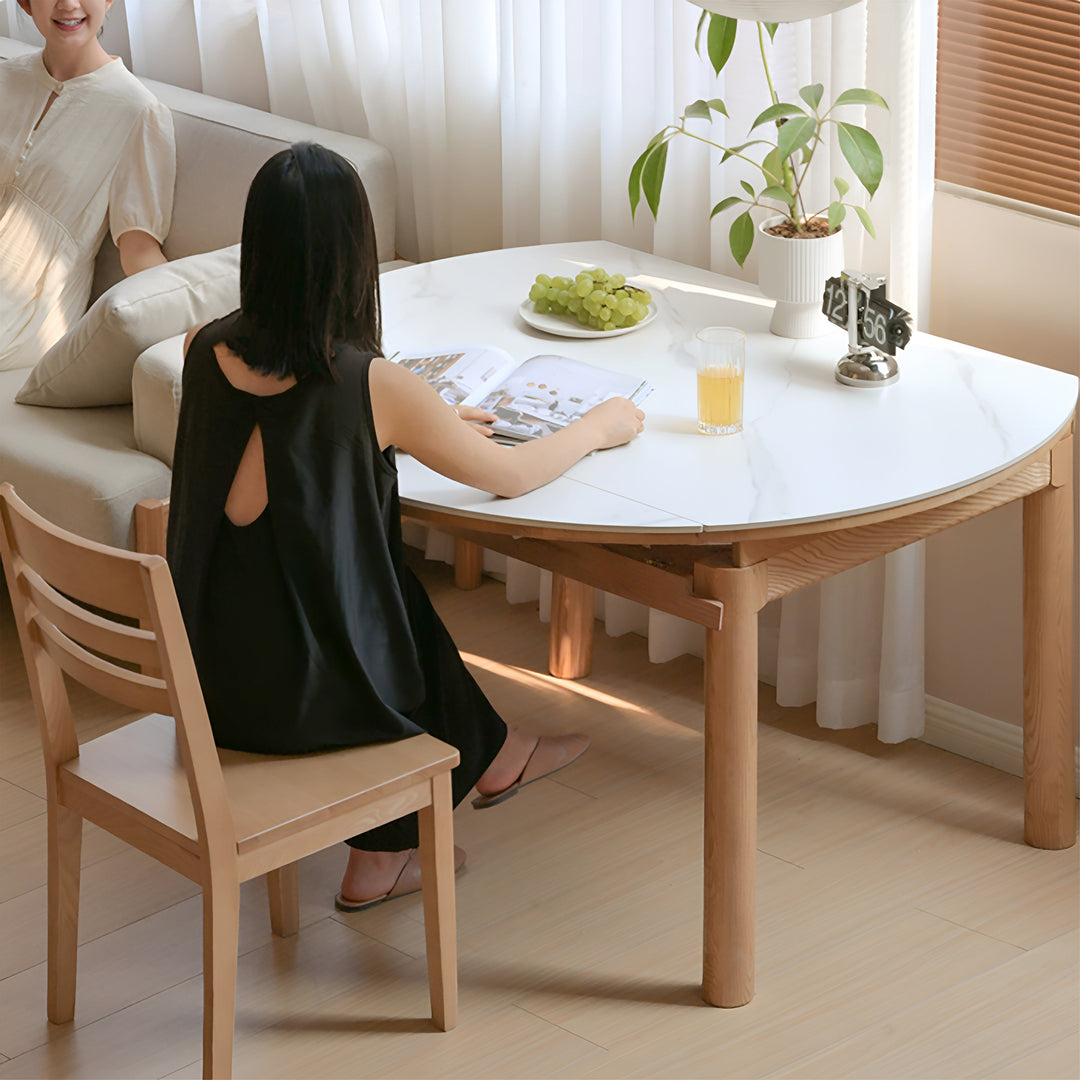
ORBIT — A Rounded Table That Expands in Width
The Scandinavian Oak Wood Sintered Stone Extendable Round Dining Table ORBIT combines a sintered stone tabletop with an oak wood frame.
ORBIT's adjustable-width design offers flexibility for gatherings while keeping the rounded look you prefer.
Because its footprint changes across the width, check the maximum extended dimensions against your available space in both directions.
SHIFT — A Longer Table for Flexible Dining
The Scandinavian Oak Wood Sintered Stone Extendable Dining Table SHIFT combines a rectangular dining surface with sintered stone and oak wood construction.
Depending on the size you choose, SHIFT extends from 47.2 to 59.1 inches or from 55.1 to 66.9 inches in length.
For a rectangular dining space, the extra length can be useful for occasional meals with guests. Be sure to check clearance at both ends when extended.

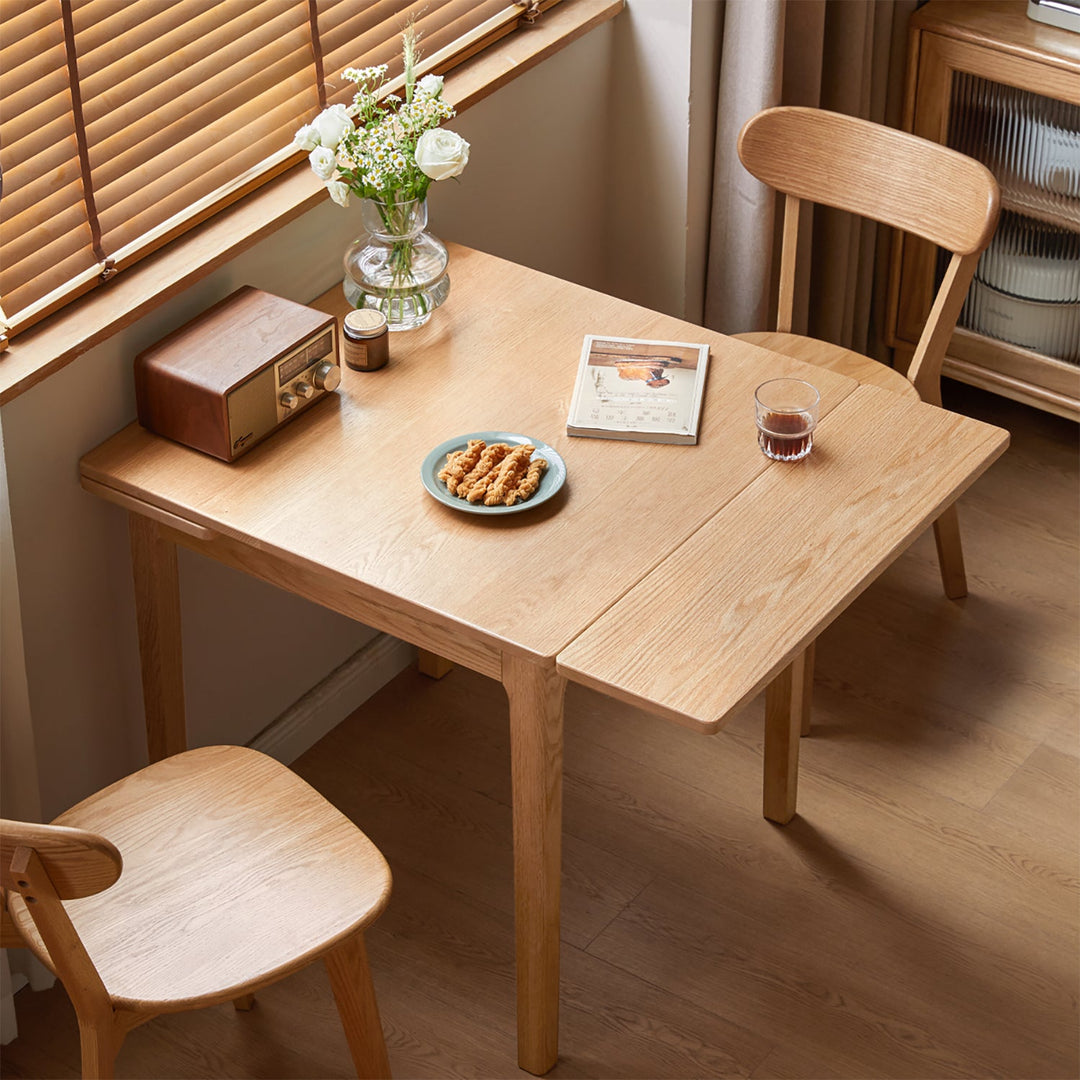
EXTENDRA — A Compact Oak Wood Option
The Scandinavian Oak Wood Extendable Dining Table EXTENDRA offers a wood tabletop rather than the sintered stone surface of the other two models.
EXTENDRA expands from 29.5 to 47.2 inches in length, with a width of 29.5 inches.
For a breakfast nook, small apartment, or dining corner where everyday space is limited, EXTENDRA gives you a compact footprint for daily meals. Its compact dimensions are appealing, but check the actual chair fit rather than assuming an advertised or estimated seating capacity.
6. So, Should You Buy One?
An extendable dining table is worth considering when you regularly use a smaller table but occasionally need extra space for guests. If the table will stay expanded most of the time, a fixed table may be simpler. If you only host a larger group once or twice a year, compare the cost and convenience of an extendable table with using a separate folding table when needed.
Before making your decision, ask yourself three questions:
- Will I use both sizes? Think about how often you entertain and whether the smaller tabletop suits your everyday meals.
- Does the fully extended table fit? Include chairs, doorways, and walking space—not just the tabletop.
- Is the extension practical for me? Check how the mechanism works, where additional sections are stored, and whether the materials suit your maintenance preferences.
For a flexible dining area, the right extendable table can offer a useful balance between everyday comfort and occasional entertaining.
The best choice is one that works well in your home when closed and still feels comfortable when everyone gathers around it.
Frequently Asked Questions
Helpful answers to common questions about expandable dining tables, stability, small spaces, extension mechanisms, and seating capacity.
Are extendable dining tables less sturdy than regular tables?
Not necessarily. A well-constructed extendable dining table can be stable, but its joints, supports, and extension hardware introduce additional components. Check the manufacturer's specifications and follow the operating instructions. Do not assume two tables have the same stability or load capacity simply because they use similar materials.
Are extendable dining tables good for small apartments?
They can be, particularly if your dining area needs to stay open most days. However, you still need enough room to use the table when fully extended. A compact closed size alone does not guarantee a good fit.
Can I leave my extendable dining table fully extended all the time?
That depends on the manufacturer's instructions and the table's design. Many extendable tables are intended to be usable in their expanded configuration, but you should confirm any model-specific requirements. If you always need the larger surface, comparing a fixed table may also make sense.
Do all extendable dining tables store their extension leaves inside?
No. Some designs have integrated or self-storing extension sections, while others require separate leaves. Verify the exact mechanism and storage arrangement for the model you're considering.
How many people can sit at an extendable dining table?
As a general starting point, allow around 24 inches of tabletop edge per adult, then adjust for chair width, armrests, and leg placement. Wider chairs may need more room, and an extension leaf doesn't automatically guarantee another comfortable seat. Check the manufacturer's seating guidance and measure your actual chairs before deciding how many people will fit.
Find a Dining Table That Fits Your Everyday Life
Explore extendable tables and compare shapes, materials, and closed-to-extended dimensions to find a design that fits your everyday meals and special gatherings.
Explore Extendable Tables


