


Round or Rectangular Dining Table? Here's How to Decide
Summarize with AI
Get a quick summary of this article using your preferred AI assistant.


Choosing a dining table involves more than finding a finish that matches your chairs. The shape affects how easily people can sit down, move around the room, and share meals together.
The quick answer: Choose a round dining table when your dining area is roughly square, you prefer an intimate seating arrangement, or you want fewer corners along a walking route. Choose a rectangular dining table when the space is longer and narrower, you regularly seat more people, or you want more length for serving dishes and everyday activities.
Neither shape is automatically better for a small home. A compact rectangular table can fit a narrow dining area more comfortably than a large round one.
Here's how to make the decision based on the room you actually have.
1. Round vs. Rectangular Dining Tables: Quick Comparison
Both shapes can work beautifully in apartments, condos, townhouses, and larger dining rooms. The difference lies in how each uses the available space.
What matters |
Round dining table |
Rectangular dining table |
|---|---|---|
Room layout |
Often suits square or open dining zones |
Often suits longer, narrower zones |
Everyday seating |
Encourages face-to-face conversation |
Offers long sides for seating multiple people |
Walking around |
No corners along the table edge |
Straight edges are useful in linear layouts |
Tabletop space |
Shared center for plates and dishes |
More length for serving, dining, or working |
Chair arrangement |
Flexible spacing with a suitable pedestal base |
Works with individual chairs, benches, or banquettes |
Larger gatherings |
Larger diameters require substantial room width |
Longer or extendable models can accommodate more seats |
Main trade-off |
Diameter takes up space in both directions |
Length and corners can obstruct circulation |
The most useful comparison is not simply round versus rectangular. It is how much space each table needs once the chairs are in place.
2. Which Shape Fits Your Dining Space Better?
A round table can feel welcoming in a compact, square-shaped dining room because it has no corners. This can be especially appealing when people approach the table from several directions.
In a narrow dining zone, however, a rectangular table may be easier to position. Its shorter width can leave more room between the chairs and nearby walls or furniture.
As a practical starting point, allow around 36 inches between the table edge and nearby walls or furniture where chairs need to move. This is a planning guideline, not a guarantee of comfortable circulation. If people need to walk behind occupied chairs, allow more room and check how far your actual chairs extend when someone is seated.
An Illustrative 9 × 11-Foot Comparison
Imagine a dining area measuring 9 feet wide by 11 feet long, with no kitchen island or other obstruction inside the measured area.
For example, compare these two dining table sizes:
- Round option: A 43.3-inch-diameter table, such as the larger PINECONE round dining table.
- Rectangular option: A 55.1 × 33.5-inch table, such as the smaller BOREL dining table.
With a 36-inch planning allowance around each table:
Measurement |
Round PINECONE |
Rectangular BOREL |
|---|---|---|
Tabletop size |
43.3-inch diameter |
55.1 × 33.5 inches |
Total planned width |
115.3 inches |
105.5 inches |
Total planned length |
115.3 inches |
127.1 inches |
Fits within a 108 × 132-inch zone with the stated allowance? |
No — exceeds the narrow dimension |
Yes — with limited spare clearance |
In this simplified comparison, the rectangular BOREL meets the assumed 36-inch clearance target, while the larger round PINECONE does not meet that target across the room’s width. The round tabletop itself still fits inside the room. The rectangular setup leaves only 2.5 inches of total spare width and 4.9 inches of total spare length beyond the assumed clearance.
This is a mathematical fit, not a guarantee of comfortable everyday use. Actual chairs, door swings, cabinets, and walking routes could make the arrangement feel too tight. The example shows why a table's overall footprint matters more than judging its shape alone.
The takeaway: A round table is not always the more space-efficient choice. Compare the full width and length of the dining setup before choosing a shape.

3. How Many People Do You Need to Seat?
Think about how many people use your dining table on an ordinary day, rather than choosing its size around the largest gathering you can imagine.
Round Tables: A More Shared Seating Experience
At a round table, everyone faces toward the same center, making it easy to include the whole group in conversation. There is no designated head of the table, which can make meals feel informal and connected.
For four people, a round dining table around 36–48 inches in diameter can be a useful starting point. However, seating comfort depends on more than diameter. A pedestal base may offer greater flexibility for chair placement, while chair width, table legs, and the space needed for shared dishes can affect how comfortably everyone sits.
Rectangular Tables: More Flexibility Along the Sides
A rectangular dining table can be a practical choice for households that regularly seat five or six people or use the table for several activities throughout the day.
Its longer sides allow chairs to sit alongside one another, while some models can accommodate extra seats at the ends. However, the position of the legs and available elbow room determine whether those end seats are genuinely comfortable.
Before choosing: Compare the seating guidance for your preferred table, if provided, with the width of your dining chairs. A stated seating capacity does not guarantee the same level of comfort with every chair style.
4. Think About Chairs, Table Legs, and Everyday Movement
Two dining tables with similar tops can provide surprisingly different seating experiences because of their bases.
A round table with a central pedestal may allow chairs to be positioned more freely around its edge. A table with widely spaced legs may create comfortable seating positions, while poorly placed legs can interfere with knees or chair placement.
Rectangular tables are also useful when you want a dining bench along one side or a banquette against a wall. But be careful about assuming a bench eliminates the need for circulation space: people still need a comfortable way to enter and leave their seats.
Consider the movement around your table throughout the day. In an apartment with an open kitchen and living area, the walking route between the refrigerator, dining chairs, and sofa can matter just as much as the size of the table.
Before buying, measure each dining chair at its widest point, including the arms if applicable. Compare that width with the usable space between the table legs, and check whether the chair arms and seat can slide beneath the tabletop without hitting the apron (the supporting frame beneath the tabletop). If you're planning seats at the ends of a rectangular table, check for legs or support beams that could limit knee room.
5. What If You Host Guests Occasionally?
You may not need a large dining table every day just because you occasionally invite friends or family for dinner.
An extendable dining table is worth considering when your regular household is small but you need additional dining space from time to time.
Rectangular extendable tables commonly increase their length, while certain round designs can expand into a different tabletop shape or provide more surface area through a moving mechanism. The exact arrangement depends on the model.
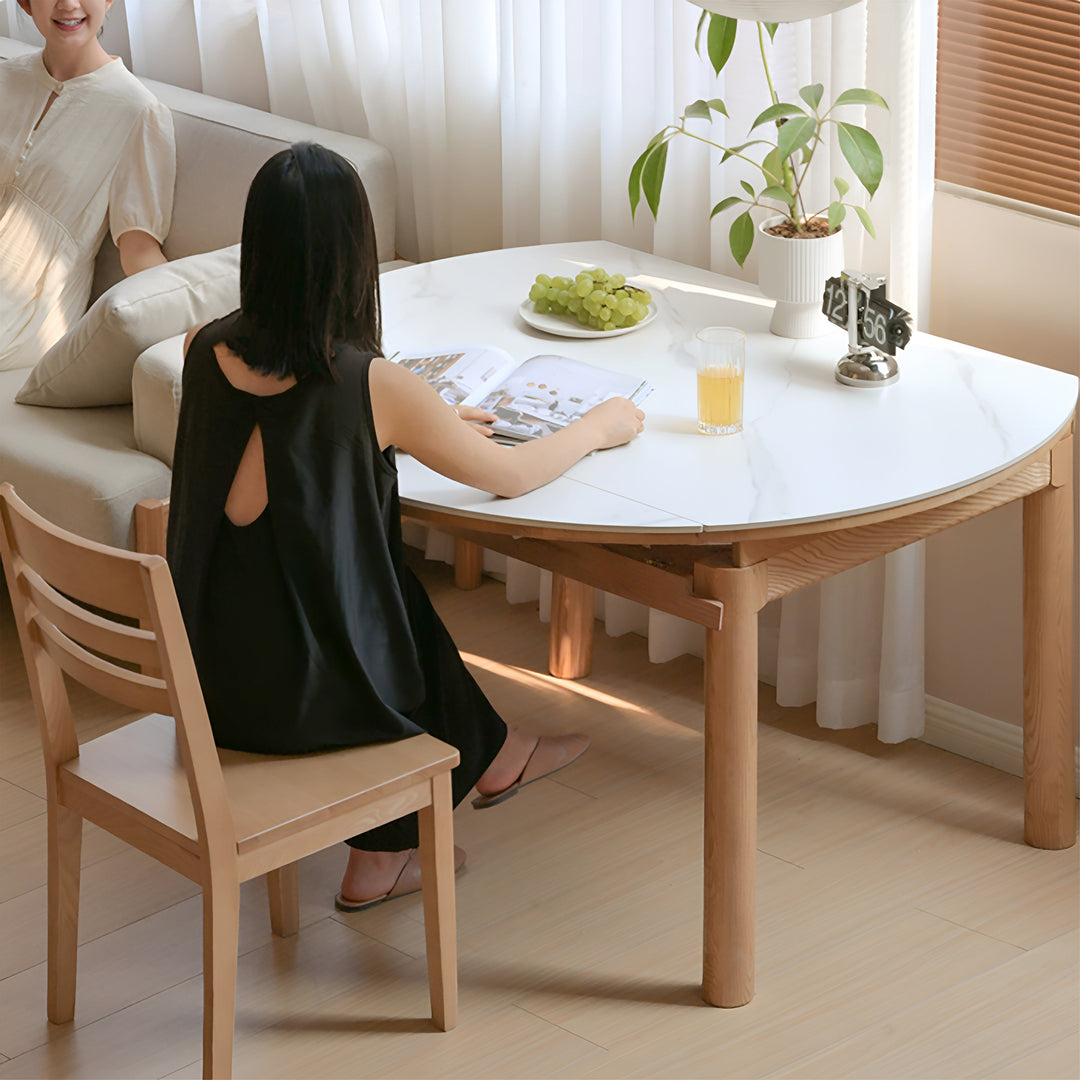
The ORBIT extendable round dining table offers an adjustable tabletop configuration for changing seating needs. Check the closed and fully extended dimensions for your selected size, particularly if the table sits near a walkway or other furniture.
Check how the extension mechanism operates and whether every chair still has enough room when the table is opened.
A table that fits perfectly when closed can easily interrupt a walkway when extended.
6. Compare Three Dining Table Options
Once you know which shape works in your dining area, the next step is to compare real dimensions, base designs, and materials.
Here are three dining table options to compare based on your room layout and seating needs.
PINECONE — A Round Dining Table in Two Sizes
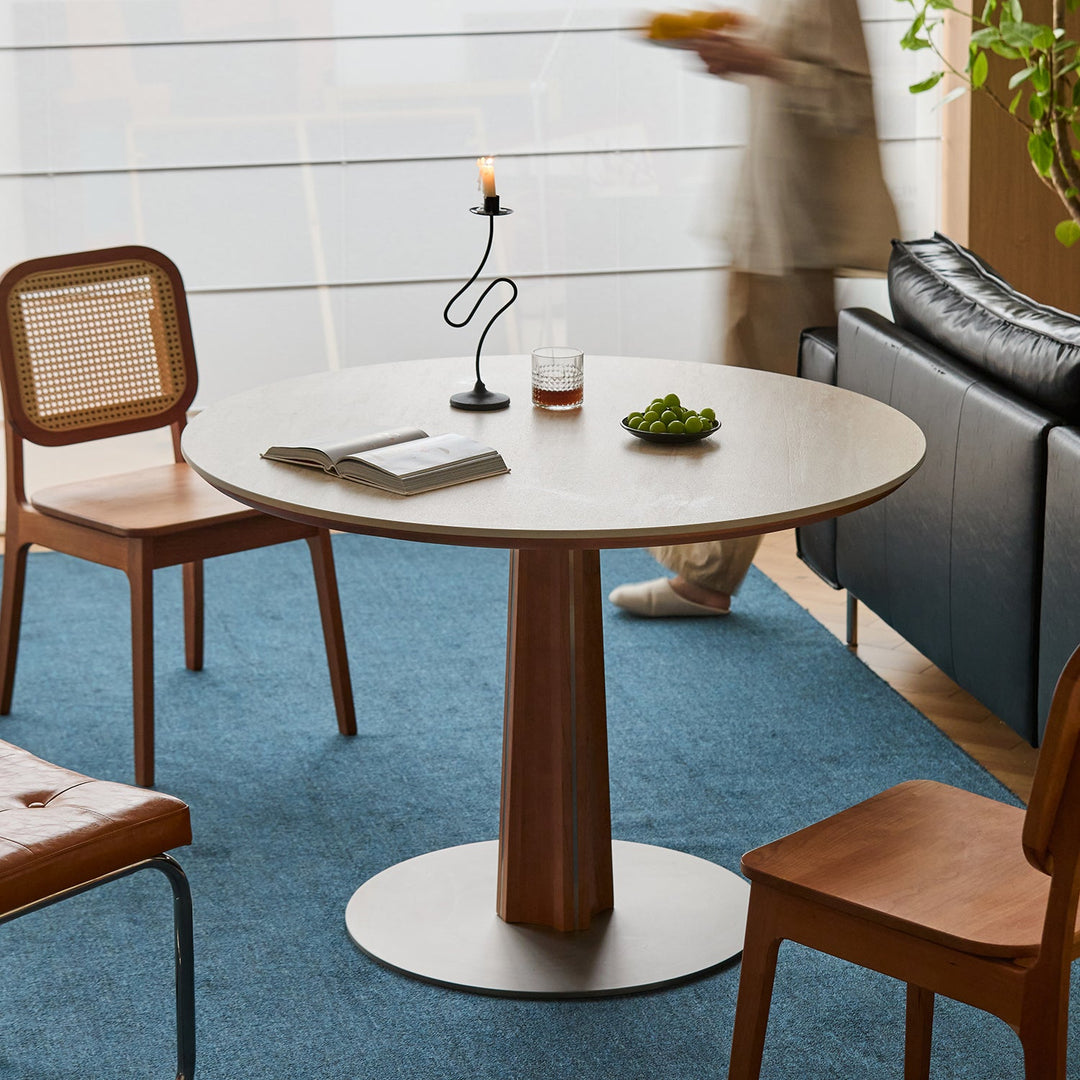
The Bauhaus Cherry Wood Sintered Stone Round Dining Table PINECONE comes in two diameter options: 37.4 inches and 43.3 inches. Comparing these sizes can help you see how a change in tabletop diameter affects the space available for chairs and movement.
Before choosing, measure the full dining area and allow enough room around the table for people to sit down, stand up, and move comfortably.
BOREL — A Rectangular Table With Multiple Length Options
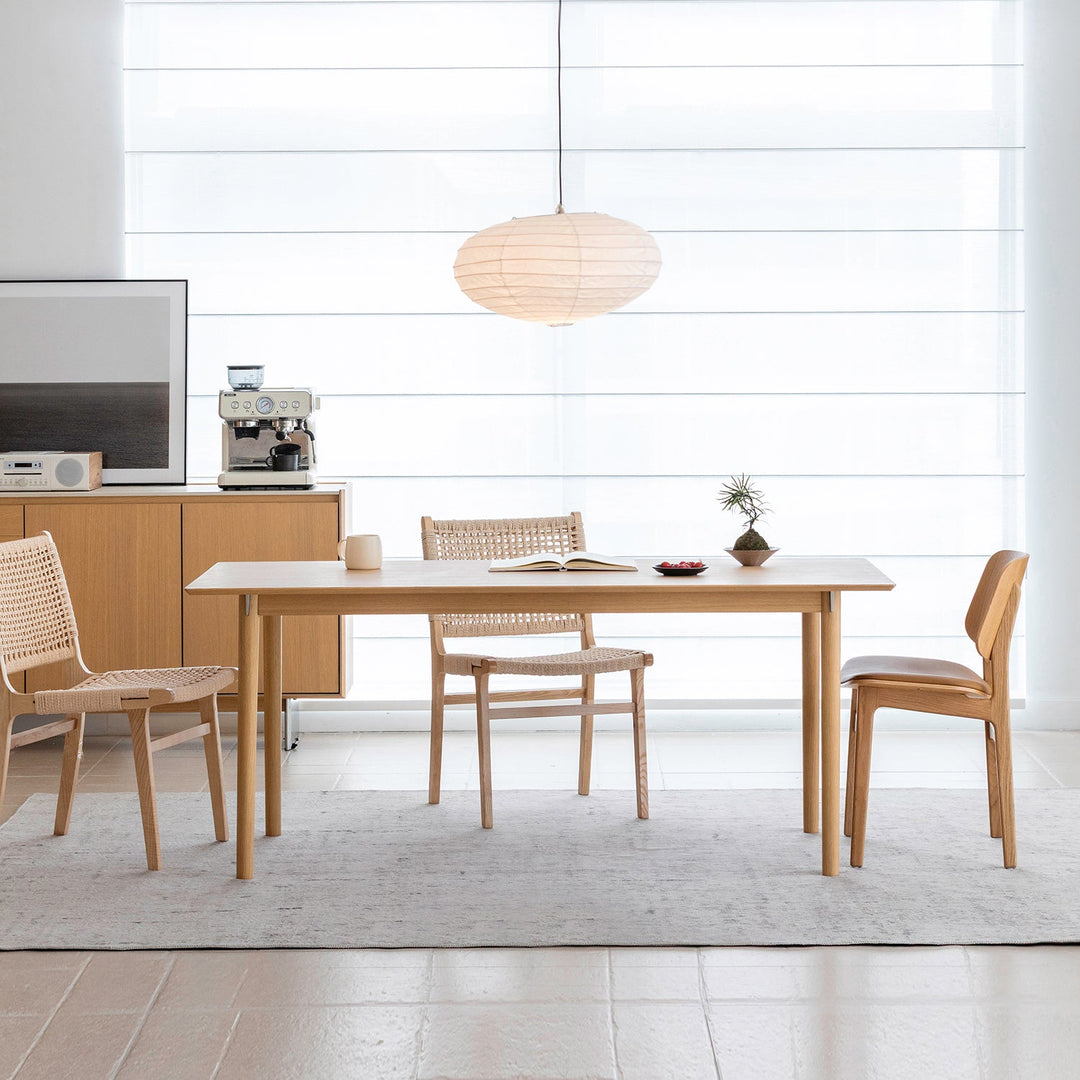
The Minimalist Ash Wood Dining Table BOREL comes in 55.1-, 63.0-, and 70.9-inch lengths, each 33.5 inches wide. These options let you compare different table lengths while keeping the tabletop width consistent.
For a longer dining area, consider how the selected length affects chair placement, seating at the ends, and the space available for everyday movement.
ORBIT — An Option for Changing Seating Needs
The Scandinavian Oak Wood Sintered Stone Extendable Round Dining Table ORBIT is an option when you want an adaptable tabletop rather than a permanently larger fixed table. Compare the closed and expanded dimensions for your chosen configuration with your dining area and chair layout.
For more options, explore our dining table collection to compare shapes, finishes, and configurations.
7. A Simple Floor-Tape Test Before You Buy
Before placing an order, use painter's tape to outline the proposed tabletop on your floor.
- Mark the table footprint. Use the exact length and width or diameter listed for your preferred table.
- Place your chairs. Position the chairs where people would actually sit, including any seats at the table ends.
- Pull the chairs out. Check the space needed to sit down, stand up, and move behind them.
- Walk your normal routes. Move between the kitchen, living area, entryway, and dining area. Open nearby doors and drawers.
- Test both shapes. Repeat the exercise with the alternative table to see which leaves a more comfortable layout.
This quick test can reveal problems that are difficult to notice from product photography or a simple measurement of the tabletop.
Also measure your doorway, hallway, stairway, or elevator route where applicable, so the chosen table or its packaged components can reach the dining area.
8. Final Thoughts
The right dining table shape depends on how you use your space, not simply which design looks better online.
Choose round when you value shared conversation, a softer outline, and a layout that comfortably accommodates its diameter. Choose rectangular when you need a narrower footprint, more tabletop length, or seating arranged along two sides.
If both shapes seem suitable, measure them with chairs in place. The table that fits your daily routine without making movement awkward is usually the better choice.
For more detailed sizing guidance, read our Dining Table Size Guide for 2 to 10 People.
Frequently Asked Questions
Still deciding between round and rectangular? These answers address common dining-table questions before you buy.
Is a round dining table better for a small space?
Not necessarily. Round tables can work well in compact, square-shaped dining areas because they have no corners. However, a rectangular table with a narrower width may fit a long, narrow room better. Always measure the tabletop and the space required for chairs.
Which dining table shape is better for four people?
Both can work well. A round table provides a conversational arrangement where everyone faces toward the center, while a rectangular table offers more defined seating positions. Compare the actual chairs, base design, and usable tabletop space before deciding.
Can six people sit comfortably at a round table?
A round dining table around 54 inches or larger can be a useful starting point for six people, but diameter alone does not guarantee comfort. Check your dining chair widths, the table's base design, and any seating guidance provided for the exact model before deciding.
Does a rectangular dining table save more space?
It can in a longer, narrower room because the tabletop width may be smaller than the diameter of a round table with similar seating capacity. However, a rectangular table can also obstruct traffic if its length or corners extend into walkways.
Are extendable dining tables a good option for small homes?
They can be useful if you need fewer seats on ordinary days and additional surface space when guests visit. Measure both the closed and fully extended configurations, including chair clearance and nearby walking routes.
Find a Dining Table That Fits Your Space
Explore our round, rectangular, and extendable dining tables. Compare dimensions, materials, and designs to find a table that works for your home.
Explore Dining Tables


